


















Variant
Price
Availability
Quantity
Buy
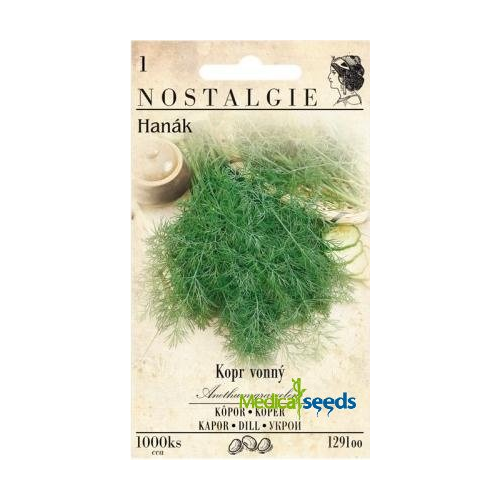
Dill is a tall annual herb. After pollination, dill flowers develop into two-seeded capsules, which disintegrate and fall off the fruit stalk when ripe. They are flat, oval in shape, with a remnant of the style at the top and a navel at the base. There is a narrow, light winged edge around the achene, the dorsal side is slightly arched, with three to four ribs, and the ventral side is flat with a scar from the fruit stalk. The pericarp is glabrous, smooth, dull to slightly shiny, brown, gray-brown, or green-brown in color, with lighter ribs. The achenes are about 3.7 mm long and 2 mm wide. The involucre contains about 500 two-seeded achenes.
The cotyledons are narrowly linear, glabrous, 25-30 mm long and 1 mm wide, pointed at the end, narrowed at the base into a short petiole, which is somewhat widened at the point of attachment. The first leaves grow alternately in the form of a basal rosette, are ovate in outline, and are several times pinnate. The first leaves are twice pinnate, with narrow linear lobes, pointed at the end; the other leaves are mostly odd-pinnate, with individual leaflets, twice to three times pinnate. The segments of the last order are thread-like and linear. The leaf petioles are 20-40 mm long, sheath-like at the base. The entire plant is glabrous.
Dill is an oriental medicinal and spice herb. In ancient Egypt, it was used to treat headaches, and in ancient Rome, it was believed to increase physical strength, which is why gladiators massaged their muscles with it before a fight and wore it in their hair during celebrations. It is also the first known doping plant – it was added to the food of professional athletes. It has been cultivated in Europe since the 3rd century. The main ingredients are vitamins, especially C, and essential oils. The leaves and fruits are used in the household, in the food and canning industries, in the production of liqueurs, and in perfumery.
The package contains 1000 seeds.